Music / Styles A–Z / American roots · 01 of 35
Blues
The blues came out of African-American communities in the Deep South around the 1860s. You know it by call and response, blue notes and, most often, the twelve-bar form.
- Where and when
- Deep South, around the 1860s
- Tempo
- Not fixed: slow laments to up-tempo jump blues
- Played on
- Voice, guitar, harmonica, piano, bass
- Lesson
- American roots →
What it is
The blues came out of African-American communities in the Deep South around the 1860s, drawing on spirituals, work songs, field hollers and narrative ballads. Its signature is the form as much as the sound: call and response, the blues scale and, most often, the twelve-bar progression. Blue notes, a third, fifth or seventh bent flat, give it the "worried" sound.
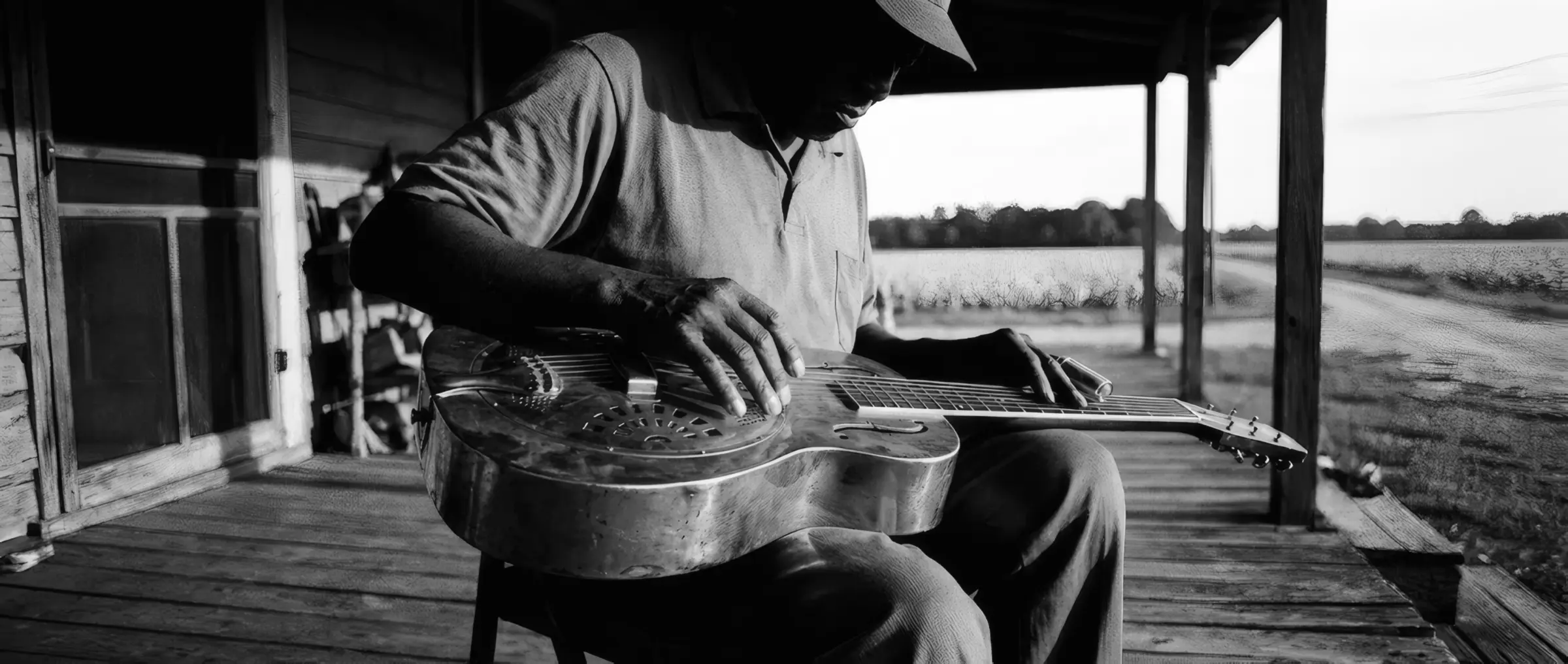
For the producer. The groove is a shuffle or a walking bass line repeated until it becomes hypnotic. Chicago players pushed the harmonica through a microphone and a PA, or overdrove the guitar amplifier: distortion was part of the style, not a fault. Kentucky's Sylvester Weaver first recorded slide guitar in 1923, fretting with a knife blade or a bottle neck.
The records that made it
From the lesson American roots, where the sources are listed · links open a search
- 1920Crazy BluesMamie Smith · Sold 75,000 copies in its first month.
- 1927Rising High Water BluesBlind Lemon Jefferson · Told of the Mississippi flood that year.
- 1948I Can't Be SatisfiedMuddy Waters · Made Chicago the centre of electric blues.
- 1983Texas FloodStevie Ray Vaughan · Took Texas blues to the world.
Blues in this month’s records
New releases the press we read wrote about, tagged blues on MusicBrainz · updated with every build