Studio / Sound of a genre / Boom bap · New York, from the 1980s
Boom bap
The name is the sound: the boom of a kick and the bap of a snare, cut out of somebody else’s record and played back on pads. Hip-hop began as other people’s breaks, looped; when samplers and drum machines became affordable, the loop moved into a box.
The kit
The Akai MPC line and E-mu’s SP-1200 are the ones producers name; any sampler that plays slices from pads does the job.
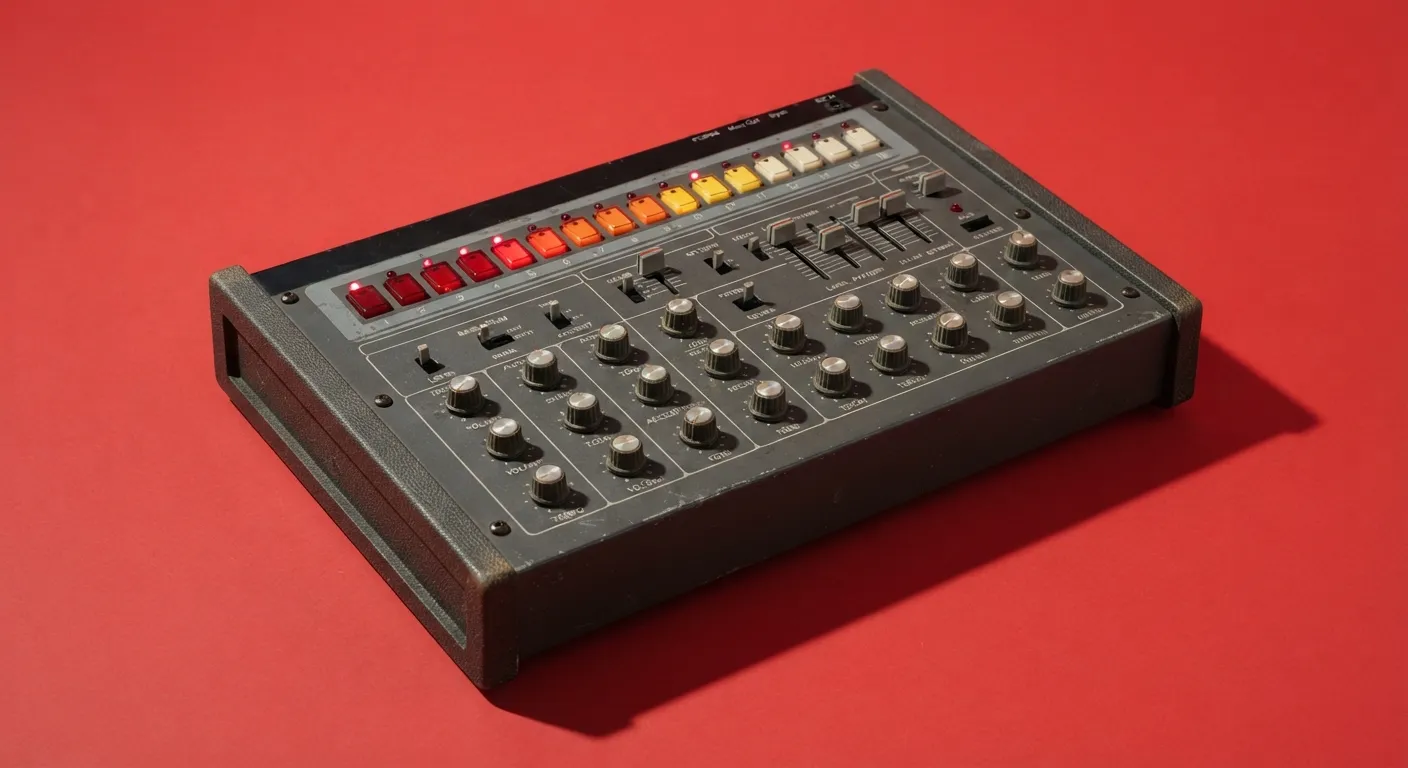
Launched in 1980 and one of the first machines the music adopted; its kick sits under a sampled break.
Two copies of the same record for the DJ; one mic for the voice, the part that defines the music.
Hip-hop, or rap, grew up with its culture in New York City in the early 1970s. Rapping is its defining voice; the DJ, turntablism, scratching and beatboxing are its other marks. At a party his sister Cindy Campbell hosted at 1520 Sedgwick Avenue in the Bronx, DJ Kool Herc began stretching the instrumental breaks of funk records by crossfading between two copies of the same disc. The Fatback Band’s “King Tim III (Personality Jock)” (1979) is generally taken as the first commercially released rap song; the Sugarhill Gang’s “Rapper’s Delight” (1979) rapped over a re-recording of Chic’s “Good Times” and became a Top 40 single; Kurtis Blow’s “The Breaks” (1980) was the first hip-hop single certified gold, and Grandmaster Flash and the Furious Five’s “The Message” (1982) opened the way for politically conscious rap. The music began as other people’s breaks, looped; when samplers, synthesizers and drum machines became affordable in the 1980s, machines such as the Akai MPC 2000, the Linn 9000 and the Roland TR-808, launched in 1980, became its tools. The tempo is not fixed by the style.
Sources: every date, name and record above comes from XLR’s own lesson Hip-hop, in Rap and bass (its sources are listed there), read 2026-11-05. The MPC60 and SP-1200 years are in the drum machines room, each with its own footnote. Akai’s current MPC page prints no history and Rossum’s SP-1200 page refused our fetch today, so no claim about either machine comes from a maker page. “Boom bap” as a name is not dated by any page we read, so we give none. The style page: Music / hip-hop.
Make it with what you own
- 01A drum break you may use: a record you own, a drummer you record, or your own kit on pads
- 02Chop the kick and the snare to two pads; play the pattern in by hand and leave it where your hands put it
- 03One bass note from any synth, following the kick; a two-bar loop of chords or a horn, filtered dark
- 04Record the voice on one mic in the quietest corner, then leave the loop alone for sixteen bars
- Acid house →
- Detroit techno →
- Dub →
- City pop Soon
- Drum & bass Soon
- Shoegaze Soon